 |
전자부품 데이터시트 검색엔진 |
|
|
전자부품 데이터시트 검색엔진 |
|
The question interval is too short.
Please try again in a few seconds.

Hello, Please ask a question about N681386 Datasheet
# Example questions:
➢ What are some of the key monitoring features provided by this chip, specifically relating to loop current and voltage sensing?
➢ What functionalities are controlled by the 'dac/adc automute function' register, and why would this feature be important in a line interface circuit?
➢ What is the purpose of registers like 'loop closure detect threshold without / with hysteresis' and 'ring trip detect threshold'?
| Part No. | N681386 |
| Manufacturer | NUVOTON |
| Size | 1Mb |
| Pages | 164 pages |
| Description | Single Programmable Extended Codec/SLCC |


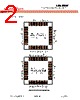
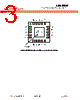

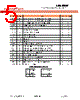


Okay, here's a breakdown of what this document is and what it describes. It's a preliminary datasheet for a complex communication chip, specifically designed for telephony applications (likely for a landline/PSTN system or similar).
Overall Purpose:
️· Datasheet: This is a technical document providing detailed specifications, functionality descriptions, and register definitions for a semiconductor chip. It's intended for engineers designing systems that will use this chip.
️· Telephony Focus: The chip is designed for voice communication, with numerous features aimed at managing line conditions, power, and signal processing specific to traditional telephone systems.
Key Areas Covered (Based on the Table of Contents):
1. General Functionality & Registers:
- PCM (Pulse Code Modulation): Likely handles the digital conversion of the analog voice signal.
- DTMF (Dual-Tone Multi-Frequency): Generates and detects tones used for entering numbers and commands in telephony.
- Line Condition Management: This is *critical*. It includes:
■ Loop Supervision: Monitors the electrical loop between the phone and the central office, detecting faults (short circuits, open lines) and managing power delivery.
■ Ground Key Detection: Detects when a phone is "off-hook" (picked up), managing line state and signal processing.
■ Ring Trip Detection: Detects when an incoming call is answered.
- Power Management:
■ DC/DC Converter: Handles voltage regulation and power delivery.
■ Battery Voltage Monitoring: Tracks the battery level.
- Signal Processing:
■ HPF (High-Pass Filter): Removes unwanted low-frequency noise.
■ Gain Control: Adjusts signal levels.
■ Hybrid Balance: Manages the impedance matching of the phone line.
2. Detailed Register Definitions: The vast majority of the document is dedicated to defining the chip's registers. Registers are memory locations within the chip that allow external systems (like a microcontroller) to configure its behavior.
- Register Structure: Each register is assigned a name, a memory address, and a description of its bits. These bits control specific functions (e.g., enable/disable features, set thresholds, configure timers).
Specific Features Highlighted:
️· Comprehensive Line Management: The chip appears to handle a complex suite of tasks related to maintaining the phone line’s electrical connection, voltage levels, and overall stability.
️· Power Efficiency: A DC/DC converter and battery voltage monitoring are critical for maximizing battery life in portable devices.
️· Programmability: The extensive register set makes the chip highly configurable to adapt to different network conditions and applications.
️· Fault Detection: Several registers are dedicated to monitoring loop conditions, ground key status, and ring trip, allowing the system to detect and respond to faults.
In simpler terms: Imagine you're building a modern version of a traditional landline phone. This chip would be the "brains" of that phone, handling all the electrical and communication complexities of connecting to the telephone network, detecting when you pick up the phone, sending and receiving signals, managing power, and more. The datasheet explains exactly how all of those features work and how to control them.
Overall Purpose:
️· Datasheet: This is a technical document providing detailed specifications, functionality descriptions, and register definitions for a semiconductor chip. It's intended for engineers designing systems that will use this chip.
️· Telephony Focus: The chip is designed for voice communication, with numerous features aimed at managing line conditions, power, and signal processing specific to traditional telephone systems.
Key Areas Covered (Based on the Table of Contents):
1. General Functionality & Registers:
- PCM (Pulse Code Modulation): Likely handles the digital conversion of the analog voice signal.
- DTMF (Dual-Tone Multi-Frequency): Generates and detects tones used for entering numbers and commands in telephony.
- Line Condition Management: This is *critical*. It includes:
■ Loop Supervision: Monitors the electrical loop between the phone and the central office, detecting faults (short circuits, open lines) and managing power delivery.
■ Ground Key Detection: Detects when a phone is "off-hook" (picked up), managing line state and signal processing.
■ Ring Trip Detection: Detects when an incoming call is answered.
- Power Management:
■ DC/DC Converter: Handles voltage regulation and power delivery.
■ Battery Voltage Monitoring: Tracks the battery level.
- Signal Processing:
■ HPF (High-Pass Filter): Removes unwanted low-frequency noise.
■ Gain Control: Adjusts signal levels.
■ Hybrid Balance: Manages the impedance matching of the phone line.
2. Detailed Register Definitions: The vast majority of the document is dedicated to defining the chip's registers. Registers are memory locations within the chip that allow external systems (like a microcontroller) to configure its behavior.
- Register Structure: Each register is assigned a name, a memory address, and a description of its bits. These bits control specific functions (e.g., enable/disable features, set thresholds, configure timers).
Specific Features Highlighted:
️· Comprehensive Line Management: The chip appears to handle a complex suite of tasks related to maintaining the phone line’s electrical connection, voltage levels, and overall stability.
️· Power Efficiency: A DC/DC converter and battery voltage monitoring are critical for maximizing battery life in portable devices.
️· Programmability: The extensive register set makes the chip highly configurable to adapt to different network conditions and applications.
️· Fault Detection: Several registers are dedicated to monitoring loop conditions, ground key status, and ring trip, allowing the system to detect and respond to faults.
In simpler terms: Imagine you're building a modern version of a traditional landline phone. This chip would be the "brains" of that phone, handling all the electrical and communication complexities of connecting to the telephone network, detecting when you pick up the phone, sending and receiving signals, managing power, and more. The datasheet explains exactly how all of those features work and how to control them.
| Part No. | N681386 |
| Manufacturer | NUVOTON |
| Size | 1Mb |
| Pages | 164 pages |
| Description | Single Programmable Extended Codec/SLCC |
| ALLDATASHEET 가 귀하에 도움이 되셨나요? [ DONATE ] |
Alldatasheet는? | 광고문의 | 운영자에게 연락하기 | 개인정보취급방침 | 링크 투 데이터시트 | 링크교환 | 제조사별 검색 All Rights Reserved©Alldatasheet.com |
| Russian : Alldatasheetru.com | Korean : Alldatasheet.co.kr | Spanish : Alldatasheet.es | French : Alldatasheet.fr | Italian : Alldatasheetit.com Portuguese : Alldatasheetpt.com | Polish : Alldatasheet.pl | Vietnamese : Alldatasheet.vn Indian : Alldatasheet.in | Mexican : Alldatasheet.com.mx | British : Alldatasheet.co.uk | New Zealand : Alldatasheet.co.nz |
|
Family Site : ic2ic.com |
icmetro.com |
 Korean ▼
  English
 Chinese
 German
 Japanese
 Russian
 Spanish
 French
 Italian
 Portuguese
 Polish
 Vietnamese
 Indian
 Mexican
 British
 New Zealand