 |
전자부품 데이터시트 검색엔진 |
|
|
전자부품 데이터시트 검색엔진 |
|
The question interval is too short.
Please try again in a few seconds.

Hello, Please ask a question about KADS-15G-R Datasheet
# Example questions:
➢ If using the 'z' input, what type of signal is expected?
➢ What is the maximum input current the kads module can handle, and what happens if that limit is exceeded?
➢ What are the acceptable power supply voltages for the kads module?
| Part No. | KADS-15G-R |
| Manufacturer | MSYSTEM |
| Size | 103 Kbytes |
| Pages | 3 pages |
| Description | Plug-in Signal Conditioners K-UNIT |


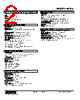
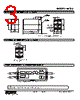

Okay, this is a very complex and detailed specification sheet for the KADS series of signal conditioners/transmitters. Let's break down the key information and create a summary.
1. What is the KADS?
The KADS is a programmable signal conditioner/transmitter. It appears to be a low-drift adder, which means it takes two input signals and combines them. It's likely used for scaling, offset adjustment, or combining multiple sensors. The description also refers to it as a "transmitter" suggesting it is intended to convert an analog signal into a standard output.
2. Key Features & Specifications
️· Programmable: The KADS can be programmed for different functions.
️· Low Drift: The "low drift" designation indicates high accuracy and stability over time and temperature changes. This is critical for precision measurements.
️· Input Signals: Accepts two input signals (Input 1 and Input 2).
️· Output: Provides an output signal, presumably an analog signal (though the type isn't explicitly stated).
️· Isolation: Contains isolation circuitry, preventing ground loops and protecting the circuitry.
️· Adder Function: The core functionality is adding the two input signals.
️· Amplifier-Based: Uses low-drift amplifiers for signal processing.
️· Signal Conditioning: Provides signal conditioning for improved accuracy and noise reduction.
3. Important Details & Notes
️· R [*]: The specification sheet notes an "R [*]" connection near the Input 2 description. This likely refers to an external resistor that can be used for adjustment or calibration of the input signal. The asterisk indicates a note or more detailed information not presented in the image.
️· Input Shunt Resistor: An input shunt resistor is used for current inputs.
️· Detailed Circuit Diagram: The sheet includes a highly detailed circuit diagram showing the components and signal flow within the device. This is very technical and requires an electronics background to fully understand.
️· Multiple Diagrams: There are multiple diagrams showing different configurations and perspectives of the circuit.
️· Terminal Numbers: The diagram includes terminal numbers for each connection, essential for correct wiring.
4. Ordering Information
️· This is not included in the provided document.
Overall, the KADS is a highly configurable and accurate signal conditioner designed for precision applications where signal combining and conditioning are required. The extensive detail within the documentation indicates this is intended for experienced technicians or engineers.
If you have specific questions about a particular aspect of the KADS or a related aspect in the documentation, please ask!
1. What is the KADS?
The KADS is a programmable signal conditioner/transmitter. It appears to be a low-drift adder, which means it takes two input signals and combines them. It's likely used for scaling, offset adjustment, or combining multiple sensors. The description also refers to it as a "transmitter" suggesting it is intended to convert an analog signal into a standard output.
2. Key Features & Specifications
️· Programmable: The KADS can be programmed for different functions.
️· Low Drift: The "low drift" designation indicates high accuracy and stability over time and temperature changes. This is critical for precision measurements.
️· Input Signals: Accepts two input signals (Input 1 and Input 2).
️· Output: Provides an output signal, presumably an analog signal (though the type isn't explicitly stated).
️· Isolation: Contains isolation circuitry, preventing ground loops and protecting the circuitry.
️· Adder Function: The core functionality is adding the two input signals.
️· Amplifier-Based: Uses low-drift amplifiers for signal processing.
️· Signal Conditioning: Provides signal conditioning for improved accuracy and noise reduction.
3. Important Details & Notes
️· R [*]: The specification sheet notes an "R [*]" connection near the Input 2 description. This likely refers to an external resistor that can be used for adjustment or calibration of the input signal. The asterisk indicates a note or more detailed information not presented in the image.
️· Input Shunt Resistor: An input shunt resistor is used for current inputs.
️· Detailed Circuit Diagram: The sheet includes a highly detailed circuit diagram showing the components and signal flow within the device. This is very technical and requires an electronics background to fully understand.
️· Multiple Diagrams: There are multiple diagrams showing different configurations and perspectives of the circuit.
️· Terminal Numbers: The diagram includes terminal numbers for each connection, essential for correct wiring.
4. Ordering Information
️· This is not included in the provided document.
Overall, the KADS is a highly configurable and accurate signal conditioner designed for precision applications where signal combining and conditioning are required. The extensive detail within the documentation indicates this is intended for experienced technicians or engineers.
| Part No. | KADS-15G-R |
| Manufacturer | MSYSTEM |
| Size | 103 Kbytes |
| Pages | 3 pages |
| Description | Plug-in Signal Conditioners K-UNIT |
| ALLDATASHEET 가 귀하에 도움이 되셨나요? [ DONATE ] |
Alldatasheet는? | 광고문의 | 운영자에게 연락하기 | 개인정보취급방침 | 링크 투 데이터시트 | 링크교환 | 제조사별 검색 All Rights Reserved©Alldatasheet.com |
| Russian : Alldatasheetru.com | Korean : Alldatasheet.co.kr | Spanish : Alldatasheet.es | French : Alldatasheet.fr | Italian : Alldatasheetit.com Portuguese : Alldatasheetpt.com | Polish : Alldatasheet.pl | Vietnamese : Alldatasheet.vn Indian : Alldatasheet.in | Mexican : Alldatasheet.com.mx | British : Alldatasheet.co.uk | New Zealand : Alldatasheet.co.nz |
|
Family Site : ic2ic.com |
icmetro.com |
 Korean ▼
  English
 Chinese
 German
 Japanese
 Russian
 Spanish
 French
 Italian
 Portuguese
 Polish
 Vietnamese
 Indian
 Mexican
 British
 New Zealand