 |
전자부품 데이터시트 검색엔진 |
|
|
전자부품 데이터시트 검색엔진 |
|
The question interval is too short.
Please try again in a few seconds.

Hello, Please ask a question about PIC16C55-XT Datasheet
# Example questions:
➢ How many bits wide is the program memory access bus for the pic16c5x, and what is the significance of this width?
➢ What is the primary difference between these services and standard programming of the chip?
➢ What architectural feature allows the pic16c5x to fetch instructions and data simultaneously, improving performance?
| Part No. | PIC16C55-XT |
| Manufacturer | MICROCHIP |
| Size | 1Mb |
| Pages | 194 pages |
| Description | EPROM/ROM-Based 8-bit CMOS Microcontroller Series |


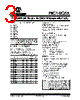








1. Overview & Architecture
️· Harvard Architecture: The PIC16C5X uses a Harvard architecture, separating program and data memory for faster access.
️· RISC Features: It incorporates RISC (Reduced Instruction Set Computing) principles, leading to efficient code execution. Specifically, it allows for instruction fetching and execution to overlap, increasing speed.
️· Instruction Size: Uses 12-bit opcodes, allowing for a compact instruction set and simplifying instruction size.
️· Instruction Cycle: Most instructions execute in a single cycle (except branches).
️· Memory:
- PIC16C54/CR54/56/CR56 address 512 x 12 program memory.
- PIC16C57/CR58 and PIC16C58/CR58 address 2K x 12 of program memory.
️· Orthogonal Instruction Set: Makes programming simpler and more efficient.
️· ALU: Features an 8-bit ALU for arithmetic and Boolean operations.
️· STATUS Register: Contains flags (Carry, Digit Carry, Zero) affected by arithmetic operations.
2. Memory and Program Memory Sizes
️· PIC16C54/CR54/56/CR56: 512 x 12 program memory
️· PIC16C57/CR57 & PIC16C58/CR58: 2048 x 12 program memory
3. Packaging/Pinout Features (Key points):
️· I/O Ports: RA0-RA3, RB0-RB7 are bi-directional I/O ports
️· T0CKI: Timer 0 clock input (can be tied to VSS or VDD if not in use)
️· MCLR/VPP: Master Clear (RESET) input, and Programming Voltage input.
️· OSC1/CLKIN & OSC2/CLKOUT: Oscillator connections. OSC2 outputs CLKOUT, which indicates instruction cycle rate.
️· VDD & VSS: Power and ground connections.
4. Programming & Production Options
️· QTP (Quick-Turnaround-Production): Factory programming service for medium to high-volume production.
️· SQTP (Serialized Quick-Turnaround Production): Devices programmed with unique serial numbers in defined locations.
️· Masked ROM: Option for low-cost production of high-volume products.
5. Key Advantages of the PIC16C5X
️· Fast Execution: Harvard architecture and RISC principles.
️· Simplicity: Orthogonal instruction set.
️· Flexibility: Multiple programming and production options.
This summary should give you a good overview of the PIC16C5X microcontroller family. Do you have any other questions about this technology or need clarification on any aspect?
1. Overview & Architecture
️· Harvard Architecture: The PIC16C5X uses a Harvard architecture, separating program and data memory for faster access.
️· RISC Features: It incorporates RISC (Reduced Instruction Set Computing) principles, leading to efficient code execution. Specifically, it allows for instruction fetching and execution to overlap, increasing speed.
️· Instruction Size: Uses 12-bit opcodes, allowing for a compact instruction set and simplifying instruction size.
️· Instruction Cycle: Most instructions execute in a single cycle (except branches).
️· Memory:
- PIC16C54/CR54/56/CR56 address 512 x 12 program memory.
- PIC16C57/CR58 and PIC16C58/CR58 address 2K x 12 of program memory.
️· Orthogonal Instruction Set: Makes programming simpler and more efficient.
️· ALU: Features an 8-bit ALU for arithmetic and Boolean operations.
️· STATUS Register: Contains flags (Carry, Digit Carry, Zero) affected by arithmetic operations.
2. Memory and Program Memory Sizes
️· PIC16C54/CR54/56/CR56: 512 x 12 program memory
️· PIC16C57/CR57 & PIC16C58/CR58: 2048 x 12 program memory
3. Packaging/Pinout Features (Key points):
️· I/O Ports: RA0-RA3, RB0-RB7 are bi-directional I/O ports
️· T0CKI: Timer 0 clock input (can be tied to VSS or VDD if not in use)
️· MCLR/VPP: Master Clear (RESET) input, and Programming Voltage input.
️· OSC1/CLKIN & OSC2/CLKOUT: Oscillator connections. OSC2 outputs CLKOUT, which indicates instruction cycle rate.
️· VDD & VSS: Power and ground connections.
4. Programming & Production Options
️· QTP (Quick-Turnaround-Production): Factory programming service for medium to high-volume production.
️· SQTP (Serialized Quick-Turnaround Production): Devices programmed with unique serial numbers in defined locations.
️· Masked ROM: Option for low-cost production of high-volume products.
5. Key Advantages of the PIC16C5X
️· Fast Execution: Harvard architecture and RISC principles.
️· Simplicity: Orthogonal instruction set.
️· Flexibility: Multiple programming and production options.
This summary should give you a good overview of the PIC16C5X microcontroller family. Do you have any other questions about this technology or need clarification on any aspect?
| Part No. | PIC16C55-XT |
| Manufacturer | MICROCHIP |
| Size | 1Mb |
| Pages | 194 pages |
| Description | EPROM/ROM-Based 8-bit CMOS Microcontroller Series |
| ALLDATASHEET 가 귀하에 도움이 되셨나요? [ DONATE ] |
Alldatasheet는? | 광고문의 | 운영자에게 연락하기 | 개인정보취급방침 | 링크 투 데이터시트 | 링크교환 | 제조사별 검색 All Rights Reserved©Alldatasheet.com |
| Russian : Alldatasheetru.com | Korean : Alldatasheet.co.kr | Spanish : Alldatasheet.es | French : Alldatasheet.fr | Italian : Alldatasheetit.com Portuguese : Alldatasheetpt.com | Polish : Alldatasheet.pl | Vietnamese : Alldatasheet.vn Indian : Alldatasheet.in | Mexican : Alldatasheet.com.mx | British : Alldatasheet.co.uk | New Zealand : Alldatasheet.co.nz |
|
Family Site : ic2ic.com |
icmetro.com |
 Korean ▼
  English
 Chinese
 German
 Japanese
 Russian
 Spanish
 French
 Italian
 Portuguese
 Polish
 Vietnamese
 Indian
 Mexican
 British
 New Zealand