 |
전자부품 데이터시트 검색엔진 |
|
|
전자부품 데이터시트 검색엔진 |
|
The question interval is too short.
Please try again in a few seconds.

Hello, Please ask a question about PC123Y22J00F Datasheet
# Example questions:
➢ Referring to figure 11, how does the collector dark current change as the ambient temperature increases?
➢ What parameters are required to measure the response time of the phototransistor?
➢ What is the approximate relationship between forward current (if) and current transfer ratio (hfe)?
| Part No. | PC123Y22J00F |
| Manufacturer | SHARP |
| Size | 294 Kbytes |
| Pages | 16 pages |
| Description | DIP 4pin Reinforced Insulation Type Photocoupler |






I. Overall Device Overview
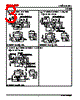
️· Type: NPN Phototransistor. Designed for optical switching, light detection, and isolation.
️· Package: Surface mountable package. (Specific package details like dimensions aren't given in this excerpt).
️· Key Features: High current gain, fast response time, and low saturation voltage.
II. Electrical Characteristics (Key Parameters)
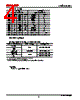
️· Dark Current (ICEO): Low dark current levels (in the range of nanoamps to microamps) are indicated, making it sensitive to light changes.
️· Collector-Emitter Voltage (VCEO): The maximum voltage the device can withstand between the collector and emitter (typically 30V, depending on variant).
️· Collector Current (IC): Up to 30mA
️· Forward Current (IF): The datasheet indicates that forward current (applied to the LED side, if used in a phototransistor pair) influences the gain and behavior.
️· Current Transfer Ratio (HFE): High gain, with a relative current transfer ratio that varies with forward current.
️· Saturation Voltage (VCE(sat)): Low saturation voltage for use in switching applications.
III. Graphs and Figures (Detailed Performance)
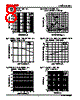
️· Fig. 7: Current Transfer Ratio vs. Forward Current: Shows how the gain (HFE) changes with the amount of light hitting the phototransistor.
️· Fig. 8: Collector Current vs. Collector-Emitter Voltage: Demonstrates the I-V characteristics of the collector-emitter junction.
️· Fig. 9: Relative Current Transfer Ratio vs. Ambient Temperature: Shows how temperature affects the gain.
️· Fig. 10: Collector-Emitter Saturation Voltage vs. Ambient Temperature: Highlights how temperature affects the saturation voltage.
️· Fig. 11: Collector Dark Current vs. Ambient Temperature: Illustrates the temperature dependence of dark current.
️· Fig. 12: Response Time vs. Load Resistance: Crucially, this shows how fast the phototransistor responds to changes in light, and how the speed is affected by the load resistance in the circuit.
️· Fig. 13: Test Circuit for Response Time: Provides the test setup for measuring the response time.
️· Fig. 14: Frequency Response: Shows the phototransistor’s ability to respond to AC signals/modulated light.
️· Fig. 15: Collector-Emitter Saturation Voltage vs. Forward Current: Illustrates the relationship between forward current and the saturation voltage.
IV. Important Considerations based on the Graphs:
️· Temperature Sensitivity: Several graphs demonstrate that performance characteristics (gain, saturation voltage, dark current) are affected by temperature.
️· Load Resistance Impact: The response time is significantly affected by the load resistance. Lower resistance = faster response (but also lower gain and sensitivity).
️· Forward Current Influence: The forward current through the LED (if part of a phototransistor pair) drastically influences the gain (HFE) of the phototransistor. This needs to be accounted for in circuit design.
️· Saturation Voltage: The device achieves a low saturation voltage (VCE(sat)), making it suitable for switching applications where a low on-resistance is desired.
V. Overall Application Potential
️· Optical Switches: A primary application due to its switching capability.
️· Light Detection: Can be used to detect the presence or absence of light.
️· Isolation: Can provide electrical isolation between circuits.
️· Object Detection: Used in proximity sensors and object detection systems.
In conclusion: This datasheet provides a comprehensive overview of the PC123N02J00F phototransistor, highlighting its electrical characteristics, temperature dependence, and performance trade-offs. Careful consideration of these factors is crucial for successful implementation in various optical sensing and switching applications.
I. Overall Device Overview
️· Type: NPN Phototransistor. Designed for optical switching, light detection, and isolation.
️· Package: Surface mountable package. (Specific package details like dimensions aren't given in this excerpt).
️· Key Features: High current gain, fast response time, and low saturation voltage.
II. Electrical Characteristics (Key Parameters)
️· Dark Current (ICEO): Low dark current levels (in the range of nanoamps to microamps) are indicated, making it sensitive to light changes.
️· Collector-Emitter Voltage (VCEO): The maximum voltage the device can withstand between the collector and emitter (typically 30V, depending on variant).
️· Collector Current (IC): Up to 30mA
️· Forward Current (IF): The datasheet indicates that forward current (applied to the LED side, if used in a phototransistor pair) influences the gain and behavior.
️· Current Transfer Ratio (HFE): High gain, with a relative current transfer ratio that varies with forward current.
️· Saturation Voltage (VCE(sat)): Low saturation voltage for use in switching applications.
III. Graphs and Figures (Detailed Performance)
️· Fig. 7: Current Transfer Ratio vs. Forward Current: Shows how the gain (HFE) changes with the amount of light hitting the phototransistor.
️· Fig. 8: Collector Current vs. Collector-Emitter Voltage: Demonstrates the I-V characteristics of the collector-emitter junction.
️· Fig. 9: Relative Current Transfer Ratio vs. Ambient Temperature: Shows how temperature affects the gain.
️· Fig. 10: Collector-Emitter Saturation Voltage vs. Ambient Temperature: Highlights how temperature affects the saturation voltage.
️· Fig. 11: Collector Dark Current vs. Ambient Temperature: Illustrates the temperature dependence of dark current.
️· Fig. 12: Response Time vs. Load Resistance: Crucially, this shows how fast the phototransistor responds to changes in light, and how the speed is affected by the load resistance in the circuit.
️· Fig. 13: Test Circuit for Response Time: Provides the test setup for measuring the response time.
️· Fig. 14: Frequency Response: Shows the phototransistor’s ability to respond to AC signals/modulated light.
️· Fig. 15: Collector-Emitter Saturation Voltage vs. Forward Current: Illustrates the relationship between forward current and the saturation voltage.
IV. Important Considerations based on the Graphs:
️· Temperature Sensitivity: Several graphs demonstrate that performance characteristics (gain, saturation voltage, dark current) are affected by temperature.
️· Load Resistance Impact: The response time is significantly affected by the load resistance. Lower resistance = faster response (but also lower gain and sensitivity).
️· Forward Current Influence: The forward current through the LED (if part of a phototransistor pair) drastically influences the gain (HFE) of the phototransistor. This needs to be accounted for in circuit design.
️· Saturation Voltage: The device achieves a low saturation voltage (VCE(sat)), making it suitable for switching applications where a low on-resistance is desired.
V. Overall Application Potential
️· Optical Switches: A primary application due to its switching capability.
️· Light Detection: Can be used to detect the presence or absence of light.
️· Isolation: Can provide electrical isolation between circuits.
️· Object Detection: Used in proximity sensors and object detection systems.
In conclusion: This datasheet provides a comprehensive overview of the PC123N02J00F phototransistor, highlighting its electrical characteristics, temperature dependence, and performance trade-offs. Careful consideration of these factors is crucial for successful implementation in various optical sensing and switching applications.
| Part No. | PC123Y22J00F |
| Manufacturer | SHARP |
| Size | 294 Kbytes |
| Pages | 16 pages |
| Description | DIP 4pin Reinforced Insulation Type Photocoupler |
| ALLDATASHEET 가 귀하에 도움이 되셨나요? [ DONATE ] |
Alldatasheet는? | 광고문의 | 운영자에게 연락하기 | 개인정보취급방침 | 링크 투 데이터시트 | 링크교환 | 제조사별 검색 All Rights Reserved©Alldatasheet.com |
| Russian : Alldatasheetru.com | Korean : Alldatasheet.co.kr | Spanish : Alldatasheet.es | French : Alldatasheet.fr | Italian : Alldatasheetit.com Portuguese : Alldatasheetpt.com | Polish : Alldatasheet.pl | Vietnamese : Alldatasheet.vn Indian : Alldatasheet.in | Mexican : Alldatasheet.com.mx | British : Alldatasheet.co.uk | New Zealand : Alldatasheet.co.nz |
|
Family Site : ic2ic.com |
icmetro.com |
 Korean ▼
  English
 Chinese
 German
 Japanese
 Russian
 Spanish
 French
 Italian
 Portuguese
 Polish
 Vietnamese
 Indian
 Mexican
 British
 New Zealand