 |
전자부품 데이터시트 검색엔진 |
|
|
전자부품 데이터시트 검색엔진 |
|
The question interval is too short.
Please try again in a few seconds.

Hello, Please ask a question about CSTCR4M00G53-R0 Datasheet
# Example questions:
➢ What specific solder composition is recommended for use with these components, and what is the acceptable range for the cream solder paste thickness?
➢ What are the temperature and humidity limits for long-term product storage, and what is the recommended storage duration before use?
➢ List at least three of these conditions.
| Part No. | CSTCR4M00G53-R0 |
| Manufacturer | MURATA1 |
| Size | 321 Kbytes |
| Pages | 16 pages |
| Description | Specification of Piezoelectric Ceramic Resonator |


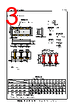






Okay, here's a breakdown of the provided document. It appears to be a manufacturing and handling document for a Murata electronic component, likely a crystal oscillator or resonator, along with its application instructions and storage guidelines.
1. General Information & Specifications (Pages 3-10 - Key Points)
️· Testing Standards: The component undergoes tests according to JISC60068-2-14 and IEC60068-2-78, indicating environmental testing and reliability compliance.
️· Operating Temperature: The operating temperature range of the component is -40°C to +85°C.
️· Material Specifications:
- Board Material: Glass epoxy (FR4) is specified for the PCB.
- Flux: Rosin-based flux is required; water-soluble flux is prohibited.
- Solder: A specific solder composition (Sn-3.0Ag-0.5Cu) is mandatory.
️· Reflow Soldering Guidelines: Detailed instructions on pre-heating, heating, and peak temperature limits for reflow soldering.
️· Manual Soldering Guidelines: Specific wattage, temperature, shape of soldering iron, time per terminal, and solder types.
️· Environmental Testing: Details on vibration and shock testing, as well as temperature cycling and humidity resistance tests.
2. Handling and Storage (Pages 14-16 - Crucial for Reliability)
️· Storage Conditions: Defined acceptable temperature and humidity ranges for storage.
️· Shelf Life: The component has a shelf life of 6 months from delivery, with recommended testing if stored longer.
️· Avoidance of Chemical Environments: Storage in corrosive or chemically reactive environments is prohibited.
️· Physical Protection: Preventing drops and physical damage is essential.
️· Unpacking and Usage: Suggests using components promptly after unpacking to avoid degradation.
3. Key Takeaways:
️· Precise Process Control: The document emphasizes the need for very precise control over soldering processes, flux types, and environmental conditions. Deviations could impact component performance and reliability.
️· Component Sensitivity: The specifications indicate that the component is sensitive to temperature, humidity, chemical exposure, and physical handling.
️· Documentation's Purpose: This document serves as a guide for engineers, technicians, and production staff involved in the manufacturing and handling of the Murata component.
To help me provide a more tailored summary, can you tell me:
* **What is the specific component?** (e.g., crystal oscillator, resonator, etc.) Knowing this allows me to refine the details.
* **What is your primary interest in this document?** (e.g., are you troubleshooting a problem, designing a circuit, ensuring proper storage?)
1. General Information & Specifications (Pages 3-10 - Key Points)
️· Testing Standards: The component undergoes tests according to JISC60068-2-14 and IEC60068-2-78, indicating environmental testing and reliability compliance.
️· Operating Temperature: The operating temperature range of the component is -40°C to +85°C.
️· Material Specifications:
- Board Material: Glass epoxy (FR4) is specified for the PCB.
- Flux: Rosin-based flux is required; water-soluble flux is prohibited.
- Solder: A specific solder composition (Sn-3.0Ag-0.5Cu) is mandatory.
️· Reflow Soldering Guidelines: Detailed instructions on pre-heating, heating, and peak temperature limits for reflow soldering.
️· Manual Soldering Guidelines: Specific wattage, temperature, shape of soldering iron, time per terminal, and solder types.
️· Environmental Testing: Details on vibration and shock testing, as well as temperature cycling and humidity resistance tests.
2. Handling and Storage (Pages 14-16 - Crucial for Reliability)
️· Storage Conditions: Defined acceptable temperature and humidity ranges for storage.
️· Shelf Life: The component has a shelf life of 6 months from delivery, with recommended testing if stored longer.
️· Avoidance of Chemical Environments: Storage in corrosive or chemically reactive environments is prohibited.
️· Physical Protection: Preventing drops and physical damage is essential.
️· Unpacking and Usage: Suggests using components promptly after unpacking to avoid degradation.
3. Key Takeaways:
️· Precise Process Control: The document emphasizes the need for very precise control over soldering processes, flux types, and environmental conditions. Deviations could impact component performance and reliability.
️· Component Sensitivity: The specifications indicate that the component is sensitive to temperature, humidity, chemical exposure, and physical handling.
️· Documentation's Purpose: This document serves as a guide for engineers, technicians, and production staff involved in the manufacturing and handling of the Murata component.
| Part No. | CSTCR4M00G53-R0 |
| Manufacturer | MURATA1 |
| Size | 321 Kbytes |
| Pages | 16 pages |
| Description | Specification of Piezoelectric Ceramic Resonator |
| ALLDATASHEET 가 귀하에 도움이 되셨나요? [ DONATE ] |
Alldatasheet는? | 광고문의 | 운영자에게 연락하기 | 개인정보취급방침 | 링크 투 데이터시트 | 링크교환 | 제조사별 검색 All Rights Reserved©Alldatasheet.com |
| Russian : Alldatasheetru.com | Korean : Alldatasheet.co.kr | Spanish : Alldatasheet.es | French : Alldatasheet.fr | Italian : Alldatasheetit.com Portuguese : Alldatasheetpt.com | Polish : Alldatasheet.pl | Vietnamese : Alldatasheet.vn Indian : Alldatasheet.in | Mexican : Alldatasheet.com.mx | British : Alldatasheet.co.uk | New Zealand : Alldatasheet.co.nz |
|
Family Site : ic2ic.com |
icmetro.com |
 Korean ▼
  English
 Chinese
 German
 Japanese
 Russian
 Spanish
 French
 Italian
 Portuguese
 Polish
 Vietnamese
 Indian
 Mexican
 British
 New Zealand