|
전자부품 데이터시트 검색엔진 |
|
|
전자부품 데이터시트 검색엔진 |
|
COP8SE 데이터시트(PDF) 24 Page - National Semiconductor (TI) |
|
|
|
|||||||||||||||||||||||||||||
COP8SE 데이터시트(HTML) 24 Page - National Semiconductor (TI) |
|
|
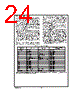
24 / 47 page  8.0 Interrupts (Continued) ample, if the Software Trap routine is located at 0310 Hex, then the vector location 0yFE and -0yFF should contain the data 03 and 10 Hex, respectively. When a Software Trap in- terrupt occurs and the VIS instruction is executed, the pro- gram jumps to the address specified in the vector table. The interrupt sources in the vector table are listed in order of rank, from highest to lowest priority. If two or more enabled and pending interrupts are detected at the same time, the one with the highest priority is serviced first. Upon return from the interrupt service routine, the next highest-level pending interrupt is serviced. If the VIS instruction is executed, but no interrupts are en- abled and pending, the lowest-priority interrupt vector is used, and a jump is made to the corresponding address in the vector table. This is an unusual occurrence, and may be the result of an error. It can legitimately result from a change in the enable bits or pending flags prior to the execution of the VIS instruction, such as executing a single cycle instruc- tion which clears an enable flag at the same time that the pending flag is set. It can also result, however, from inadvert- ent execution of the VIS command outside of the context of an interrupt. The default VIS interrupt vector can be useful for applica- tions in which time critical interrupts can occur during the servicing of another interrupt. Rather than restoring the pro- gram context (A, B, X, etc.) and executing the RETI instruc- tion, an interrupt service routine can be terminated by return- ing to the VIS instruction. In this case, interrupts will be serviced in turn until no further interrupts are pending and the default VIS routine is started. After testing the GIE bit to ensure that execution is not erroneous, the routine should restore the program context and execute the RETI to return to the interrupted program. This technique can save up to fifty instruction cycles (t c), or more, (50µs at 10 MHz oscillator) of latency for pending in- terrupts with a penalty of fewer than ten instruction cycles if no further interrupts are pending. To ensure reliable operation, the user should always use the VIS instruction to determine the source of an interrupt. Al- though it is possible to poll the pending bits to detect the source of an interrupt, this practice is not recommended. The use of polling allows the standard arbitration ranking to be al- tered, but the reliability of the interrupt system is compro- mised. The polling routine must individually test the enable and pending bits of each maskable interrupt. If a Software Trap interrupt should occur, it will be serviced last, even though it should have the highest priority. Under certain con- ditions, a Software Trap could be triggered but not serviced, resulting in an inadvertent “locking out” of all maskable inter- rupts by the Software Trap pending flag. Problems such as this can be avoided by using VIS instruction. TABLE 4. Interrupt Vector Table Arbitration Ranking Source Description Vector Address (Note 26) (Hi-Low Byte) (1) Highest Software INTR Instruction 0yFE–0yFF (2) Reserved 0yFC–0yFD (3) External G0 0yFA–0yFB (4) Timer T0 Underflow 0yF8–0yF9 (5) Timer T1 T1A/Underflow 0yF6–0yF7 (6) Timer T1 T1B 0yF4–0yF5 (7) MICROWIRE/PLUS BUSY Low 0yF2–0yF3 (8) EERAM EERAM Write Complete 0yF0–0yF1 (9) Reserved 0yEE–0yEF (10) Reserved 0yEC–0yED (11) Reserved 0yEA–0yEB (12) Reserved 0yE8–0yE9 (13) Reserved 0yE6–0yE7 (14) Reserved 0yE4–0yE5 (15) Port L/Wakeup Port L Edge 0yE2–0yE3 (16) Lowest Default VIS Reserved 0yE0–0yE1 Note 26: y is a variable which represents the VIS block. VIS and the vector table must be located in the same 256-byte block except if VIS is located at the last ad- dress of a block. In this case, the table must be in the next block. www.national.com 24 |
|
링크 URL |
| ALLDATASHEET 가 귀하에 도움이 되셨나요? [ DONATE ] |
Alldatasheet는? | 광고문의 | 운영자에게 연락하기 | 개인정보취급방침 | 링크 투 데이터시트 | 링크교환 | 제조사별 검색 All Rights Reserved©Alldatasheet.com |
| Russian : Alldatasheetru.com | Korean : Alldatasheet.co.kr | Spanish : Alldatasheet.es | French : Alldatasheet.fr | Italian : Alldatasheetit.com Portuguese : Alldatasheetpt.com | Polish : Alldatasheet.pl | Vietnamese : Alldatasheet.vn Indian : Alldatasheet.in | Mexican : Alldatasheet.com.mx | British : Alldatasheet.co.uk | New Zealand : Alldatasheet.co.nz |
|
Family Site : ic2ic.com |
icmetro.com |
 Korean ▼
 English
 Chinese
 German
 Japanese
 Russian
 Korean
 Spanish
 French
 Italian
 Portuguese
 Polish
 Vietnamese
 Indian
 Mexican
 British
 New Zealand